
Turn leadership development into leadership excellence.
Developing your leaders is only part of the solution.
Developing capable leaders matters. But individual development alone does not create leadership excellence across an organization.
Care Deeply’s 4E Leadership Operating System creates the clarity, capability, and consistency required to turn stronger individual leaders into stronger organizational performance.

Capability Alone Is Not Enough.
Excellence requires clarity, capability, and consistency.
Leadership development strengthens capability. It does not, by itself, establish the clear expectations or consistent practices needed to achieve excellence.
Clarity. Leadership excellence begins with clear standards. You’ve already declared your values, but your leaders need more. They need the guidance of defined leadership behaviors.
Capability. Leaders need the skills, tools, and judgment required to enact that standard under real-world conditions.
Consistency. The standard needs to be regularly referenced, reinforced, and reviewed so leadership remains aligned across roles, teams, and changing circumstances.
Infrastructure Is Not a System.
Leadership excellence requires an operating system.
You already have some leadership infrastructure in place—company values, leadership development, performance management, feedback, assessments, and other practices intended to strengthen leadership.
When those efforts operate independently from a common standard of excellence, they create mixed expectations, develop leaders toward different targets, or result in feedback founded in personal preferences.
A leadership operating system connects those efforts and creates the recurring practices needed to develop, reinforce, and evaluate leadership over time.
“You do not rise to the level of your goals. You fall to the level of your systems.”
—James Clear, Atomic Habits
Four Functions. One Integrated System.
The 4E Leadership Operating System.
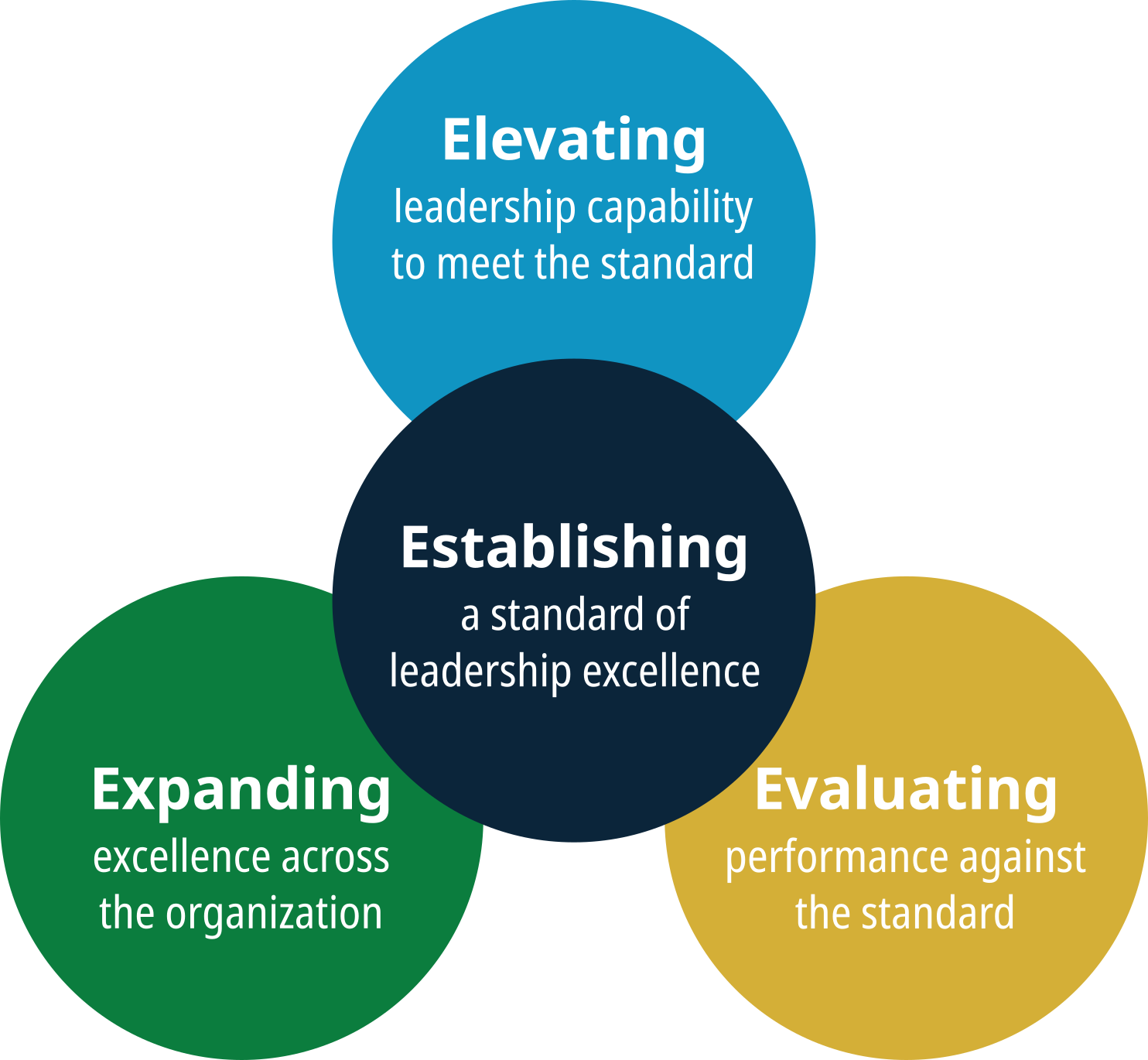
Care Deeply’s 4E Leadership Operating System (4E LOS) organizes your leadership infrastructure through four connected functions:
Establishing. Defines the standard of leadership excellence and creates the clarity leaders need to understand what the organization expects.
Elevating. Builds the capability—skills, tools, and judgment—leaders need to enact that standard under real conditions.
Expanding. Creates consistency by reinforcing the standard across the organization, so expectations, capabilities, and responsibilities extend beyond a small number of leaders.
Evaluating. Creates regular visibility into how well the standard is understood and practiced—and where greater clarity, capability, or consistency may be needed.
Together, they create the clarity, capability, and consistency required for excellence.
Leadership Development By Itself
✘ Learning remains concentrated among the people who directly receive development.
✘ New behaviors fade when day-to-day operations reinforce different expectations.
✘ Results depend heavily on individual leaders applying what they learned.
✘ Feedback, development, and accountability are left to individual interpretation.
✘ Individual leaders improve. Organizational performance remains the same.
4E Leadership Operating System
✔ Leadership expectations, capabilities, and responsibilities extend across the organization.
✔ Recurring practices reinforce the standard between development events.
✔ Leaders support one another in achieving the standard of excellence.
✔ Feedback, development, and accountability all reference the same standard.
✔ Individual leaders improve. So does the organization.
Leadership Development By Itself
4E Leadership Operating System
✘ Learning remains concentrated among the people who directly receive development.
✔ Leadership expectations, capabilities, and responsibilities extend across the organization.
✘ New behaviors fade when day-to-day operations reinforce different expectations.
✔ Recurring practices reinforce the standard between development events.
✘ Results depend heavily on individual leaders applying what they learned.
✔ Leaders support one another in achieving the standard of excellence.
✘ Feedback, development, and accountability are left to individual interpretation.
✔ Feedback, development, and accountability all reference the same standard.
✘ Individual leaders improve. Organizational performance remains the same.
✔ Individual leaders improve. So does the organization.
WHAT LEADERSHIP EXCELLENCE MAKES POSSIBLE.
Stronger performance.
A culture that scales.
A company that endures.
A leadership operating system makes leadership excellence part of how the organization operates—so performance can remain strong, responsibility can expand, and the culture can endure as the company grows and leadership changes.
Decisions stay closer to the work, accountability becomes more reliable, and senior leaders regain capacity to focus on what comes next for the business.
As responsibility expands across more people, teams, and locations, leadership expectations remain consistent and organizational excellence spreads.


WHERE SHOULD YOU BEGIN?
Start where the need is greatest.
You don’t need to build the entire system at once. You already have leadership infrastructure—some working well, some misaligned, and some still missing.
The right starting point depends on where the standard needs greater clarity, where leaders need greater capability to enact it, or where greater consistency is needed in application and reinforcement.
Care Deeply’s Organizational Leadership Assessment can help you identify where to begin. Take the Assessment →
Prefer to talk about it?
Schedule a Conversation →